[转载]项目优化经验——垃圾回收导致的性能问题

mikel阅读(999)

[转载]项目优化经验——垃圾回收导致的性能问题 – lovecindywang – 博客园.

谈谈最近优化一个网站项目的经验,首先说一下背景情况:

1) 在页面后台代码中我们把页面上大部分的HTML都使用字符串来拼接生成然后直接赋值给LiteralControl。

2) 网站CPU很高,基本都在80%左右,即使使用了StringBuilder来拼接字符串性能也不理想。

3) 为了改善性能,把整个字符串保存在memcached中,性能还是不理想。

在比较了这个网站和其它网站服务器上相关性能监视器指标后发 现有一个参数特别显眼:

image

就是其中的每秒分配字节数,这个性能比较差的网 站每秒分配2GB的内存(而且需要注意由于性能监视器是每秒更新一下,对于一个非常健康的网站这个值应该经常看到是0才对)!而其它一些网站只分配 200M左右的内存。服务器配备4G内存,而每秒分配2G内存,我想垃圾回收器一定需要不断运行来回收这些内存。观察%Time in GC可以发现,这个值一直在10%左右,也就是说上次回收到这次回收间隔10秒的话,这次垃圾回收1秒,由于回收的时间相对固定,那么这个值可以反映回收 的频繁度。

知道了这个要点就知道了方向,在项目中找可能的问题点:

1) 是否分配了大量临时的小对象

2) 是否分配了数量不多但比较大的大对象

在经历了一番查找之后,发现一个比较大的问题,虽然使用了memcached来缓存整个页面的 HTML,但是在输出之前居然进行了几次string的Replace操作,这样就产生了几个大的字符串,我们来做一个实验模拟这种场景:

public partial class _Default : System.Web.UI.Page
{
    static string template;
    protected void Page_Load(object sender, EventArgs e)
    {
        if (template == null)
        {
            StringBuilder sb = new StringBuilder();
            for (int i = 0; i < 10000; i++)
                sb.Append("1234567890");
            template = sb.ToString(); 
        }

        Stopwatch sw = Stopwatch.StartNew();

        for (int i = 0; i < 1; i++)
        {
            long mem1 = GC.GetTotalMemory(false);
            string s = template + i;
            long mem2 = GC.GetTotalMemory(false);
            Response.Write((mem2 - mem1).ToString("N0"));
            Response.Write("<br/>");
            GC.KeepAlive(s);
        }

        for (int i = 0; i < 100000; i++)
        {
            double d = Math.Sqrt(i);
        }

        Thread.Sleep(30);
        Response.Write(sw.ElapsedMilliseconds);
    }
}

在这段代码中:

1) 我们首先使用一个静态变量模拟缓存中的待输出的HTML

2) 我们中间的一段代码测算一下这个字符串占用的内存空间

3) 随后我们做了一些消耗CPU的运算操作来模拟页面的一些计算

4) 然后休眠一段时间

4) 最后我们输出了页面执行时间

我们这么做的目的是模拟一个比较“正常的”ASP.NET页面需要做的一些工作:

1) 内存上的分配

2) 一些计算

3) 涉及到IO访问的一些等待

来看看输出结果:

image

这里可以看到,我们这个字符串占用差不多200K的字节,字符串是字符数组,CLR中字符采用Unicode双字节存储,因此10万长度的字符串占 用200千字节,并且也可以看到这个页面执行时间30毫秒,差不多是一个正常aspx页面的时间,而200K不到的字符串也差不多相当于这个页面的 HTML片段,现在我们来改一下其中的一段代码模拟优化前进行的Replace操作带来的几个大字符串:

for (int i = 0; i < 10; i++)
{
    //long mem1 = GC.GetTotalMemory(false);
    string s = template + i;
    //long mem2 = GC.GetTotalMemory(false);
    //Response.Write((mem2 - mem1).ToString("N0"));
    //Response.Write("<br/>");
    //GC.KeepAlive(s);
}

然后使用IDE自带压力测试1000常量用户来测试这个页面:

image

可以看到每秒分配了超过400M字节(这和我们线上环境比还差点毕竟请求少),CPU占用基本在120-160左右(双核),我们去掉每秒分配内存 这个数值,来看看垃圾回收频率和CPU占用两个值的图表:

image

可以看到红色的CPU波动基本和蓝色的垃圾回收波动保持一致(这里不太准确的另外一个原因是压力测试客户端运行于本机,而为w3wp关联2个处理 器)!为什么说垃圾回收会带来CPU的波动,从理论上来说有以下原因:

1) 垃圾回收的时候会暂时挂起所有线程,然后GC会检测扫描每一个线程栈上可回收对象,然后会移动对象,并且重新设置对象指针,这整个过程首先是消耗CPU的

2) 而且在这个过程之后恢复线程执行,这个时候CPU往往会引起一个高峰因为已经有更多的请求等待了

我们把Math.Sqrt这段代码注释掉并且把w3wp和VSTestHost关联到不同的处理器来看看对于CPU计算很少的页面,上图更明显的对 比:

image

这说明垃圾回收的确会占用很多CPU资源,但这只是一部分,其实我觉得网站的CPU压力来自于几个地方:

1) 就是大量的内存分配带来的垃圾回收所占用的CPU,对于ASP.NET框架内部的很多行为无法控制,但是可以在代码中尽量避免在堆上产生很多不必要的对象

2) 是实际的CPU运算,不涉及IO的运算,这些可以通过改良算法来优化,但是优化比较有限

3) 是IO操作这块,数据量的多少很关键,还有要考虑memcached等外部缓存对象序列化反序列化的消耗

4) 虽然很多IO操作不占用CPU资源,线程处于休眠状态,但是很多时候其实是依托新线程进行的,带来的就是线程切换和线程创建消耗的消耗,这一块可以通过合 理使用多线程来优化

发现了这个问题之后优化就很简单了,把Replace操作放到memcached的Set操作之前,取出之后不产生过多大字符串,把for循环改为 一次,再来看一下:

image

image

这次内存分配明显少了很多,CPU降下来了,降的不多,但从压力测试监视器中看到页面执行平均时间从5秒变为3秒了,每秒平均请求数从170到了 200(最高从200到了300)。在这里要说明一点很多时候网站的性能优化不能光看CPU还要对比优化前后网站的负载,因为在优化之后页面执行时间降低 了,负载量就增大了CPU消耗也随之增大。并且可以看到垃圾回收频率的缩短很明显,从长期在30%到几十秒一次30%。

最后想补充几点:

1) 有的时候我们会使用GC.GetTotalMemory(true); 来得到垃圾回收之后内存分配数,类似这样涉及到垃圾回收的代码在项目上线后千万不能出现,否则很可能会% Time in GC达到80%以上大量占用CPU。

2) 对于放在缓存中的对象我们往往会觉得性能得到保障大量去使用,其实缓存实现的只是把创造这个对象过程的时间转化为空间,而在拿到这个对象之后再进行很多运 算带来的大量空间始终会进行垃圾回收。做网站和做应用程序不一样,一个操作如果申请200K堆内存,一个页面执行这个操作10次,一秒200多个请求,大 家可以自己算一下平均每秒需要分配多少内存,这个数值是相当可怕的,网站是一个多线程的环境,我们对内存的使用要考虑更多。

作者:lovecindywang
本文版权归作者和博客园共有,欢迎转载,但未经作者同意必须保留此段声明,且在文章页面明显位置给出原文连接,否则保留追究法律责任的权利。

[转载]什么是软件的MSDN版、OEM版、RTM版?

mikel阅读(878)

(一)MSDN (Microsoft Developer Network)版 MSDN软件是微软公司面向软件开发者的一种版本。MSDN 涵盖了所有可以被开发扩充的平台和应用程序,如微软公司的百科全书 Encarta,或者是各种游戏,是不包括在 MSDN 之内的,因为这些产品直接面向最终用户,没有进行程序开发的必要。 (二) OEM(Original Equipment Manufacturer)版 OEM软件只能随机器出货,不能零售,所以也叫做随机版。OEM软件只能全新安装,不能从旧有操作系统升级。如果买笔记型计算机或品牌计算机就会有随机版软件。包装不像零售版精美,通常只有一片cd和说明书(授权书)。这种系统通常会少一些驱动,而且目前的OEM软件很少放在光盘里能给你安装,要么就是恢复盘,要么就是硬盘镜像。 (三) RTM(Release to Manufacturing)版 软件在正式在零售商店上架前,需要一段时间来压片,包装、配销,所以程序代码必须在正式发行前一段时间就要完成,这个完成的程序代码叫做 final.code,程序代码开发完成之后,要将母片送到工厂大量压片,这个版本就叫做rtm版。rtm版的程序码和正式版一样。但是和正式版也有不一样的地方:例如正式版中的oem不能升级安装,升级版要全新安装的话会检查旧版操作系统光盘等,这些就是Rtm和正式版不同的地方,但是它们的主要程序代码都是一样的。严格的说这种版本还是属于fpp零售版,需要激活。

[转载]深入分析 ASP.NET Mvc 1.0

mikel阅读(921)

[转载]深入分析 ASP.NET Mvc 1.0 – ModelBinder – Never give up – 博客园.

前一篇文章已经讲叙Controller.Execute(…)方法的执行流程中会调用 ControllerActionInvoker类的InvokeAction(ControllerContext controllerContext, string actionName)方法, 在InvokeAction(…)方法内又调用了GetParameterValues(…)方法,这个方法为Action中的每个参数赋值,追踪到 GetParameterValues(…)方法内部会发现其实每个参数的值是由GetParameterValue(…)返回的,观察 GetParameterValue(…)方法的源码:

protected virtual object GetParameterValue(ControllerContext controllerContext, ParameterDescriptor parameterDescriptor) {
            // collect all of the necessary binding properties
            Type parameterType = parameterDescriptor.ParameterType;
            IModelBinder binder = GetModelBinder(parameterDescriptor);
            IDictionary<string, ValueProviderResult> valueProvider = controllerContext.Controller.ValueProvider;
            string parameterName = parameterDescriptor.BindingInfo.Prefix ?? parameterDescriptor.ParameterName;
            Predicate<string> propertyFilter = GetPropertyFilter(parameterDescriptor);

            // finally, call into the binder
            ModelBindingContext bindingContext = new ModelBindingContext() {
                FallbackToEmptyPrefix = (parameterDescriptor.BindingInfo.Prefix == null), // only fall back if prefix not specified
                ModelName = parameterName,
                ModelState = controllerContext.Controller.ViewData.ModelState,
                ModelType = parameterType,
                PropertyFilter = propertyFilter,
                ValueProvider = valueProvider
            };
            object result = binder.BindModel(controllerContext, bindingContext);
            return result;
        }

代码的逻辑分为:

  1. 获取继承了IModelBinder接口的对象
  2. 执行IModelBinder对象的BindModel(…)方法并返回Action的参数值

继承IModelBinder接口的对象有三个类:DefaultModelBinder, FormCollectionModelBinderHttpPostedFileBaseModelBinder

在GetParameterValue(…)方法中可以看到由GetModelBinder(parameterDescriptor)负责返回 IModelBinder对象,但他是如何确定返回哪个ModeBinder的呢?

  • 当Action的参数类型为FormCollection时,GetParameterValue(…)方法返回 FormCollectoinModelBinder对象
  • 当Action的参数类型为HttpPostedFileBase时,GetParameterValue(…)方法返回 HttpPostedFileBaseModelBinder对象
  • 当Action的参数类型除了FormCollection和HttpPostedFileBase外(int, string, boolean或强类型),GetParameterValue(…)方法返回DefaultModelBinder对 象,DefaultModelBinder也是最常用的ModelBinder

来深入到GetModelBinder(…)方法的内部

private IModelBinder GetModelBinder(ParameterDescriptor parameterDescriptor) {
            // look on the parameter itself, then look in the global table
            return parameterDescriptor.BindingInfo.Binder ?? Binders.GetBinder(parameterDescriptor.ParameterType);
        }

通常情况下IModelBinder都是由 Binders.GetBinder(parameterDescriptor.ParameterType)返回, Binders属性调用ModelBinders.Binders返回ModelBinderDictionary的静态实例,在调用 ModelBinders.Binders属性返回ModelBinderDictionary对象之前先初始化 ModelBinderDictionary对象并将HttpPostedFileBaseModelBinder保存到 ModelBinderDictionary对象中(代码如下),最后其实是调用ModelBinderDictionary的GetBinder()方 法返回的IModelBinder对象。

public static class ModelBinders {
        private static readonly ModelBinderDictionary _binders = CreateDefaultBinderDictionary();

        public static ModelBinderDictionary Binders {
            get {
                return _binders;
            }
        }
        
        private static ModelBinderDictionary CreateDefaultBinderDictionary() {
            // We can't add a binder to the HttpPostedFileBase type as an attribute, so we'll just
            // prepopulate the dictionary as a convenience to users.

            ModelBinderDictionary binders = new ModelBinderDictionary() {
                { typeof(HttpPostedFileBase), new HttpPostedFileBaseModelBinder() }
            };
            return binders;
        }

    }

ModelBinderDictionary的GetBinder()方法

public IModelBinder GetBinder(Type modelType) {
            return GetBinder(modelType, true /* fallbackToDefault */);
        }

        public virtual IModelBinder GetBinder(Type modelType, bool fallbackToDefault) {
            if (modelType == null) {
                throw new ArgumentNullException("modelType");
            }

            return GetBinder(modelType, (fallbackToDefault) ? DefaultBinder : null);
        }

        private IModelBinder GetBinder(Type modelType, IModelBinder fallbackBinder) {
            // Try to look up a binder for this type. We use this order of precedence:
            // 1. Binder registered in the global table
            // 2. Binder attribute defined on the type
            // 3. Supplied fallback binder

            IModelBinder binder;
            if (_innerDictionary.TryGetValue(modelType, out binder)) {
                return binder;
            }

            binder = ModelBinders.GetBinderFromAttributes(modelType,
                () => String.Format(CultureInfo.CurrentUICulture, MvcResources.ModelBinderDictionary_MultipleAttributes, modelType.FullName));

            return binder ?? fallbackBinder;
        }

在签名为private IModelBinder GetBinder(Type modelType, IModelBinder fallbackBinder) 的方法中会最返回IModelBinder对象,并且可以看出如果Action的参为类型为HttpPostedFileBase时,在 _innerDictionary.TryGetValue(modelType, out binder) 时就可能找到这个IModelBinder并返回;如果参数的类型为FormCollection 时,ModelBinders.GetBinderFromAttributes()会返回FormControllerModelBinder否则会返 回fallbackBinder也主是DefaultModelBinder对象

来看一个DefaultModelBinder对象的BindModel(…)方法的代码:

public virtual object BindModel(ControllerContext controllerContext, ModelBindingContext bindingContext) {
            if (bindingContext == null) {
                throw new ArgumentNullException("bindingContext");
            }

            bool performedFallback = false;

            if (!String.IsNullOrEmpty(bindingContext.ModelName) && !DictionaryHelpers.DoesAnyKeyHavePrefix(bindingContext.ValueProvider, bindingContext.ModelName)) {
                // We couldn't find any entry that began with the prefix. If this is the top-level element, fall back
                // to the empty prefix.
                if (bindingContext.FallbackToEmptyPrefix) {
                    bindingContext = new ModelBindingContext() {
                        Model = bindingContext.Model,
                        ModelState = bindingContext.ModelState,
                        ModelType = bindingContext.ModelType,
                        PropertyFilter = bindingContext.PropertyFilter,
                        ValueProvider = bindingContext.ValueProvider
                    };
                    performedFallback = true;
                }
                else {
                    return null;
                }
            }

            // Simple model = int, string, etc.; determined by calling TypeConverter.CanConvertFrom(typeof(string))
            // or by seeing if a value in the request exactly matches the name of the model we're binding.
            // Complex type = everything else.
            if (!performedFallback) {
                ValueProviderResult vpResult;
                bindingContext.ValueProvider.TryGetValue(bindingContext.ModelName, out vpResult);
                if (vpResult != null) {
                    return BindSimpleModel(controllerContext, bindingContext, vpResult);
                }
            }
            if (TypeDescriptor.GetConverter(bindingContext.ModelType).CanConvertFrom(typeof(string))) {
                return null;
            }

            return BindComplexModel(controllerContext, bindingContext);
        }

if (!String.IsNullOrEmpty(bindingContext.ModelName) && !DictionaryHelpers.DoesAnyKeyHavePrefix(bindingContext.ValueProvider, bindingContext.ModelName))  查找指定的参数名是否包含在ValueProvider中,有两种情况:

  1. 在ValueProvider找到指定的参数名: 一般都是简单类型(int, boolean, string)或数组(页面中相同name的元素会以数组的形式赋给指定的参数)
  2. 没有在ValueProvider中找到指定的参数名:通常情况下都是strongly-typed类型,因为他的参数名不能与页面中的name 属性相同,否则会有异常被抛出;还有一种情况就是页面中元素的name属性与Action的参数名不一致,这时如果参数不能接收null类型就会有异常抛 出 。

接着上面的if语句,如果没有找到指定的参数并且 ModelBindingContext.FallbackToEmptyPrefix==true,那么就重新创建一个 ModelBindingContext对象,并设置performedFallback = true。

接下来的代码分两步执行:

  • BindSimpleModel(controllerContext, bindingContext, vpResult): 为简单对象返回参数值
  • BindComplexModel(controllerContext, bindingContext): 返 回complex对象(这里我理解为strongly-typed)的参数值
1. 首先看看BindSimpleModel(…)方法的过程:
internal object BindSimpleModel(ControllerContext controllerContext, ModelBindingContext bindingContext, ValueProviderResult valueProviderResult) {
            bindingContext.ModelState.SetModelValue(bindingContext.ModelName, valueProviderResult);

            // if the value provider returns an instance of the requested data type, we can just short-circuit
            // the evaluation and return that instance
            if (bindingContext.ModelType.IsInstanceOfType(valueProviderResult.RawValue)) {
                return valueProviderResult.RawValue;
            }

            // since a string is an IEnumerable<char>, we want it to skip the two checks immediately following
            if (bindingContext.ModelType != typeof(string)) {

                // conversion results in 3 cases, as below
                if (bindingContext.ModelType.IsArray) {
                    // case 1: user asked for an array
                    // ValueProviderResult.ConvertTo() understands array types, so pass in the array type directly
                    object modelArray = ConvertProviderResult(bindingContext.ModelState, bindingContext.ModelName, valueProviderResult, bindingContext.ModelType);
                    return modelArray;
                }

                Type enumerableType = ExtractGenericInterface(bindingContext.ModelType, typeof(IEnumerable<>));
                if (enumerableType != null) {
                    // case 2: user asked for a collection rather than an array
                    // need to call ConvertTo() on the array type, then copy the array to the collection
                    object modelCollection = CreateModel(controllerContext, bindingContext, bindingContext.ModelType);
                    Type elementType = enumerableType.GetGenericArguments()[0];
                    Type arrayType = elementType.MakeArrayType();
                    object modelArray = ConvertProviderResult(bindingContext.ModelState, bindingContext.ModelName, valueProviderResult, arrayType);

                    Type collectionType = typeof(ICollection<>).MakeGenericType(elementType);
                    if (collectionType.IsInstanceOfType(modelCollection)) {
                        CollectionHelpers.ReplaceCollection(elementType, modelCollection, modelArray);
                    }
                    return modelCollection;
                }
            }

            // case 3: user asked for an individual element
            object model = ConvertProviderResult(bindingContext.ModelState, bindingContext.ModelName, valueProviderResult, bindingContext.ModelType);
            return model;
        }

valueProviderResult.RawValue就是简单类型的参数值,if (bindingContext.ModelType.IsInstanceOfType(valueProviderResult.RawValue)) 是判断RawValue是否是指定的参数类型的实例,如果是那就直接返回RawValue。 跳转到最后ConvertProviderResult(…)方法处进行分析,上面的代码都是对数组的操作,最后也还是会调用 ConvertProviderResult(…)方法,来看看ConvertProviderResult(…)方法的代码:

[SuppressMessage("Microsoft.Design", "CA1031:DoNotCatchGeneralExceptionTypes",
            Justification = "We're recording this exception so that we can act on it later.")]
        private static object ConvertProviderResult(ModelStateDictionary modelState, string modelStateKey, ValueProviderResult valueProviderResult, Type destinationType) {
            try {
                object convertedValue = valueProviderResult.ConvertTo(destinationType);
                return convertedValue;
            }
            catch (Exception ex) {
                modelState.AddModelError(modelStateKey, ex);
                return null;
            }
        }

调用ValueProviderResult类(ValueProviderResult.cs)的ConvertTo方法, 后又跳转到UnwrapPossibleArrayType(…)方法

        public object ConvertTo(Type type) {
            return ConvertTo(type, null /* culture */);
        }

        public virtual object ConvertTo(Type type, CultureInfo culture) {
            if (type == null) {
                throw new ArgumentNullException("type");
            }

            CultureInfo cultureToUse = culture ?? Culture;
            return UnwrapPossibleArrayType(cultureToUse, RawValue, type);
        }

        private static object UnwrapPossibleArrayType(CultureInfo culture, object value, Type destinationType) {
            if (value == null || destinationType.IsInstanceOfType(value)) {
                return value;
            }

            // array conversion results in four cases, as below
            Array valueAsArray = value as Array;
            if (destinationType.IsArray) {
                Type destinationElementType = destinationType.GetElementType();
                if (valueAsArray != null) {
                    // case 1: both destination + source type are arrays, so convert each element
                    IList converted = Array.CreateInstance(destinationElementType, valueAsArray.Length);
                    for (int i = 0; i < valueAsArray.Length; i++) {
                        converted[i] = ConvertSimpleType(culture, valueAsArray.GetValue(i), destinationElementType);
                    }
                    return converted;
                }
                else {
                    // case 2: destination type is array but source is single element, so wrap element in array + convert
                    object element = ConvertSimpleType(culture, value, destinationElementType);
                    IList converted = Array.CreateInstance(destinationElementType, 1);
                    converted[0] = element;
                    return converted;
                }
            }
            else if (valueAsArray != null) {
                // case 3: destination type is single element but source is array, so extract first element + convert
                if (valueAsArray.Length > 0) {
                    value = valueAsArray.GetValue(0);
                    return ConvertSimpleType(culture, value, destinationType);
                }
                else {
                    // case 3(a): source is empty array, so can't perform conversion
                    return null;
                }
            }
            // case 4: both destination + source type are single elements, so convert
            return ConvertSimpleType(culture, value, destinationType);
        }

在UnwrapPossibleArrayType(…)方法中首先是一些对数组的判断和操作,如果参数的类型不是Array那么就运行最后一行的 ConvertSimpleType(…)方法并返回参数值

private static object ConvertSimpleType(CultureInfo culture, object value, Type destinationType) {
            if (value == null || destinationType.IsInstanceOfType(value)) {
                return value;
            }

            // if this is a user-input value but the user didn't type anything, return no value
            string valueAsString = value as string;
            if (valueAsString != null && valueAsString.Length == 0) {
                return null;
            }

            TypeConverter converter = TypeDescriptor.GetConverter(destinationType);
            bool canConvertFrom = converter.CanConvertFrom(value.GetType());
            if (!canConvertFrom) {
                converter = TypeDescriptor.GetConverter(value.GetType());
            }
            if (!(canConvertFrom || converter.CanConvertTo(destinationType))) {
                string message = String.Format(CultureInfo.CurrentUICulture, MvcResources.ValueProviderResult_NoConverterExists,
                    value.GetType().FullName, destinationType.FullName);
                throw new InvalidOperationException(message);
            }

            try {
                object convertedValue = (canConvertFrom) ?
                     converter.ConvertFrom(null /* context */, culture, value) :
                     converter.ConvertTo(null /* context */, culture, value, destinationType);
                return convertedValue;
            }
            catch (Exception ex) {
                string message = String.Format(CultureInfo.CurrentUICulture, MvcResources.ValueProviderResult_ConversionThrew,
                    value.GetType().FullName, destinationType.FullName);
                throw new InvalidOperationException(message, ex);
            }
        }

TypeConverter converter = TypeDescriptor.GetConverter(destinationType) 来返回一个destinationType类型TypeConverter转换器,并用convert.CanConvertFrom和 CanConvertTo两个方法是否可以从value.GetType()转换为destationType类型,如果可以转换那么就将转换的返回给 Action对应的参数,否则换出一个异常。

2. BindComplexModel

在BindComplexModel中只讨论strongly-typed。先来看看BindComplexModel(…)方法的代码

internal object BindComplexModel(ControllerContext controllerContext, ModelBindingContext bindingContext) {
            object model = bindingContext.Model;
            Type modelType = bindingContext.ModelType;
            
            // if we're being asked to create an array, create a list instead, then coerce to an array after the list is created
            if (model == null && modelType.IsArray) {
                Type elementType = modelType.GetElementType();
                Type listType = typeof(List<>).MakeGenericType(elementType);
                object collection = CreateModel(controllerContext, bindingContext, listType);

                ModelBindingContext arrayBindingContext = new ModelBindingContext() {
                    Model = collection,
                    ModelName = bindingContext.ModelName,
                    ModelState = bindingContext.ModelState,
                    ModelType = listType,
                    PropertyFilter = bindingContext.PropertyFilter,
                    ValueProvider = bindingContext.ValueProvider
                };
                IList list = (IList)UpdateCollection(controllerContext, arrayBindingContext, elementType);

                if (list == null) {
                    return null;
                }

                Array array = Array.CreateInstance(elementType, list.Count);
                list.CopyTo(array, 0);
                return array;
            }

            if (model == null) {
                model = CreateModel(controllerContext,bindingContext,modelType);
            }

            // special-case IDictionary<,> and ICollection<>
            Type dictionaryType = ExtractGenericInterface(modelType, typeof(IDictionary<,>));
            if (dictionaryType != null) {
                Type[] genericArguments = dictionaryType.GetGenericArguments();
                Type keyType = genericArguments[0];
                Type valueType = genericArguments[1];

                ModelBindingContext dictionaryBindingContext = new ModelBindingContext() {
                    Model = model,
                    ModelName = bindingContext.ModelName,
                    ModelState = bindingContext.ModelState,
                    ModelType = modelType,
                    PropertyFilter = bindingContext.PropertyFilter,
                    ValueProvider = bindingContext.ValueProvider
                };
                object dictionary = UpdateDictionary(controllerContext, dictionaryBindingContext, keyType, valueType);
                return dictionary;
            }

            Type enumerableType = ExtractGenericInterface(modelType, typeof(IEnumerable<>));
            if (enumerableType != null) {
                Type elementType = enumerableType.GetGenericArguments()[0];

                Type collectionType = typeof(ICollection<>).MakeGenericType(elementType);
                if (collectionType.IsInstanceOfType(model)) {
                    ModelBindingContext collectionBindingContext = new ModelBindingContext() {
                        Model = model,
                        ModelName = bindingContext.ModelName,
                        ModelState = bindingContext.ModelState,
                        ModelType = modelType,
                        PropertyFilter = bindingContext.PropertyFilter,
                        ValueProvider = bindingContext.ValueProvider
                    };
                    object collection = UpdateCollection(controllerContext, collectionBindingContext, elementType);
                    return collection;
                }
            }

            // otherwise, just update the properties on the complex type
            BindComplexElementalModel(controllerContext, bindingContext, model);
            return model;
        }

先从ModelBindingContext中 获取model和modelType,在BindComplexModel方法的中间判断model是否为null,如果不是将调用 CreateModel(…)方法来创建一个strongly-typed对象的实例: if (model == null) { model = CreateModel(controllerContext,bindingContext,modelType); } 。跳转到倒数第二行的BindComplexElementalModel(…)方法处

internal void BindComplexElementalModel(ControllerContext controllerContext, ModelBindingContext bindingContext, object model) {
            // need to replace the property filter + model object and create an inner binding context
            BindAttribute bindAttr = (BindAttribute)TypeDescriptor.GetAttributes(bindingContext.ModelType)[typeof(BindAttribute)];
            Predicate<string> newPropertyFilter = (bindAttr != null)
                ? propertyName => bindAttr.IsPropertyAllowed(propertyName) && bindingContext.PropertyFilter(propertyName)
                : bindingContext.PropertyFilter;

            ModelBindingContext newBindingContext = new ModelBindingContext() {
                Model = model,
                ModelName = bindingContext.ModelName,
                ModelState = bindingContext.ModelState,
                ModelType = bindingContext.ModelType,
                PropertyFilter = newPropertyFilter,
                ValueProvider = bindingContext.ValueProvider
            };

            // validation
            if (OnModelUpdating(controllerContext, newBindingContext)) {
                BindProperties(controllerContext, newBindingContext);
                OnModelUpdated(controllerContext, newBindingContext);
            }
        }

先获取参数前面的BindAttribute,创建一个新的ModelBindingContext对 象并重新设置了PropertyFilter属性,在下面的if语句中调用了三个方法,OnModelUpdating(…)永远返回true,接着是 BindProperties(…),这个方法为strongly-typed对象的每个属性赋值,来看看它的源码:

private void BindProperties(ControllerContext controllerContext, ModelBindingContext bindingContext) {
            PropertyDescriptorCollection properties = GetModelProperties(controllerContext, bindingContext);
            foreach (PropertyDescriptor property in properties) {
                BindProperty(controllerContext, bindingContext, property);
            }
        }

调用GetModelProperties(…)方法返回一个PropertyDescriptorCollection 集合对象,注意,这个集合不一定是stronly-typed中的全部属性,在GetModelProperties()方法中会根据参 数前面定义的BindAttribute.Incude和BindAttribute.Exclude过滤掉不被使用的属性,将那些确定使用的属性存放到PropertyDescriptorCollection 中。 在foreach中调用BindProperty(…)为每个可用的属性赋值,

protected virtual void BindProperty(ControllerContext controllerContext, ModelBindingContext bindingContext, PropertyDescriptor propertyDescriptor) {
            // need to skip properties that aren't part of the request, else we might hit a StackOverflowException
            string fullPropertyKey = CreateSubPropertyName(bindingContext.ModelName, propertyDescriptor.Name);
            if (!DictionaryHelpers.DoesAnyKeyHavePrefix(bindingContext.ValueProvider, fullPropertyKey)) {
                return;
            }

            // call into the property's model binder
            IModelBinder propertyBinder = Binders.GetBinder(propertyDescriptor.PropertyType);
            object originalPropertyValue = propertyDescriptor.GetValue(bindingContext.Model);
            ModelBindingContext innerBindingContext = new ModelBindingContext() {
                Model = originalPropertyValue,
                ModelName = fullPropertyKey,
                ModelState = bindingContext.ModelState,
                ModelType = propertyDescriptor.PropertyType,
                ValueProvider = bindingContext.ValueProvider
            };
            object newPropertyValue = propertyBinder.BindModel(controllerContext, innerBindingContext);

            // validation
            if (OnPropertyValidating(controllerContext, bindingContext, propertyDescriptor, newPropertyValue)) {
                SetProperty(controllerContext, bindingContext, propertyDescriptor, newPropertyValue);
                OnPropertyValidated(controllerContext, bindingContext, propertyDescriptor, newPropertyValue);
            }
        }

在BindProperty(…)内部递归调用IModelBinder.GetBinder(…)方法来为属性赋值。

ModelBinder并不复杂,Action所有的参数值都是循环调用IModelBinder.GetBinder()方法获得,而 complex类型递归调用IModelBinder来为complex类型的可用属性赋值。

[转载]泛型委托在项目中的应用

mikel阅读(998)

[转载]泛型委托在项目中的应用 – ASP.NET2.0 – 博客园.

感悟:对泛型委托基本属于有点认识,但从来没真正在项目中使用过,有时感觉没有合适的场景应用,但看 了artech兄 的文章,我才明白,原来泛型委托真的可以做很多事情,而且效果往往是没有使用委托所达不到的。

Action<T> 泛型委托:封装一个方法,该方法只采用一个参数并且不返回值。可以使 用此委托以参数形式传递方法,而不用显式声明自定义的委托。该方法必须与此委托定义的方法签名相对应。也就是说,封装的方法必须具有一个通过值传递给它的 参数,并且不能返回值。当然泛型委托不只是只能支持一个参数,它最多可以支持四个参数。

泛型委托与直接显示声明自定义委托的示例比较:

1:显示声明自定义委托:

代码

delegate void DisplayMessage(string message);
public class TestCustomDelegate
{
public static void Main()
{
DisplayMessage messageTarget;
messageTarget
= ShowWindowsMessage;
messageTarget(
Hello, World!);
}
private static void ShowWindowsMessage(string message)
{
MessageBox.Show(message);
}
}

2: Action<T> 用法。比起自定义委托,明显可以看出代码简洁了。

代码

public class TestAction1
{
public static void Main()
{
Action
<string> messageTarget;
messageTarget
= ShowWindowsMessage;
messageTarget(
Hello, World!);
}
private static void ShowWindowsMessage(string message)
{
MessageBox.Show(message);
}
}

Func<T, TResult> 委托:封装一个具有一个参数并返回 TResult 参数指定的类型值的方法。同理,这里的泛型委托只是接受一个参数的委托,它最多同样支持四个参数。TResult:此委托封装的方法的返回值类型。
问题:目前本公司在写程序时,都使用了log4net,我想大家在做异常时,都会利用try catch来捕获异常,日志就在catch块中完成,但每个方法都写一堆的try catch往往显的有点别扭。虽然写程序时提倡尽量去捕获具体的错误异常,但总会有你预想不到的异常抛出,为此直接捕获Exception算是不错的做 法。

具体场景:在客户端调用WCF服务时,我们都需要在客户做异常处理,最常见的错误异常为 CommunicationException,TimeoutException,Exception示例如下:

代码

try
{
//执行方法调用
……
(proxy
as ICommunicationObject).Close();
}
catch (CommunicationException ex)
{
(proxy
as ICommunicationObject).Abort();

WebLog.SquareLog.CommonLogger.Error(取积分广场首页酒店数据异常CommunicationException: + ex.ToString());
}
catch (TimeoutException ex)
{
(proxy
as ICommunicationObject).Abort();
WebLog.SquareLog.CommonLogger.Error(
取积分广场首页酒店数据超时TimeoutException: + ex.ToString());
}
catch (Exception ex)
{
(proxy
as ICommunicationObject).Close();
WebLog.SquareLog.CommonLogger.Error(
取积分广场首页酒店数据异常Exception: + ex.ToString());
}

但如果这种代码遍布整个项目,我想就有重构的必要了,因为项目中最好不要出现类似复制的代码出现,为此我们可以采用Invoke形式来重构我们已有代码, 下面给出两个方法,一个是没有返回值的,一个是有值的。

代码

public static void Invoke<TContract>(TContract proxy, Action<TContract> action)
{
try
{
action(proxy);
(proxy
as ICommunicationObject).Close();
}
catch (CommunicationException ex)
{
(proxy
as ICommunicationObject).Abort();
WebLog.SquareLog.CommonLogger.Error(
取积分广场首页酒店数据异常CommunicationException: + ex.ToString());
}
catch (TimeoutException ex)
{
(proxy
as ICommunicationObject).Abort();
WebLog.SquareLog.CommonLogger.Error(
取积分广场首页酒店数据超时TimeoutException: + ex.ToString());
}
catch (Exception ex)
{
(proxy
as ICommunicationObject).Close();
WebLog.SquareLog.CommonLogger.Error(
取积分广场首页酒店数据异常Exception: + ex.ToString());
}
}
public static TReturn Invoke<TContract, TReturn>(TContract proxy, Func<TContract, TReturn> func)
{
TReturn returnValue
= default(TReturn);
try
{
returnValue
= func(proxy);
}
catch (CommunicationException ex)
{
(proxy
as ICommunicationObject).Abort();

WebLog.SquareLog.CommonLogger.Error(取积分广场首页酒店数据异常CommunicationException: + ex.ToString());
}
catch (TimeoutException ex)
{
(proxy
as ICommunicationObject).Abort();

WebLog.SquareLog.CommonLogger.Error(取积分广场首页酒店数据超时TimeoutException: + ex.ToString());
}
catch (Exception ex)
{
WebLog.SquareLog.CommonLogger.Error(
取积分广场首页酒店数据异常Exception: + ex.ToString());
}
return returnValue;
}

如何调用:可以看出客户端代码已经变成一条简洁代码了,它即完成了完整的异常处理,而且也把所有能 够捕获的异常信息记录下来。

list = ErrorHandler.Invoke<ISearchHotelForSquare, List<HotelGenericInfo>>(cli, proxy => proxy.GetHotelGenericListForSquare(requestInfo).ToList());

说明:至于Invoke的应用,在System .Runtime .Remoting.Proxies有一个RealProxy,可以称做真正代理,里面有IMessage Invoke(System.Runtime.Remoting.Messaging.IMessage msg)方法:只不过这里面没有应用泛型委托。

代码

// 返回结果:
// The message returned by the invoked method, containing the return value and
// any out or ref parameters.
public abstract IMessage Invoke(IMessage msg);

[转载]6款开源微博客程序

mikel阅读(1448)

[转载]6款开源微博客程序 | CoCo Bauer.

6款开源微博客程序

twitter, 饭否, 叽歪,嘀吐等一众微博客皆受伤,但挡不住广大群众对微博客这种形式的热情。或许你愿意自己搭建一个微博客,尽管这看上去没什么意义: 你搭建一个就几个人玩的微博客,那比喊谁谁谁回家还要无趣。但可能有的站长朋友有远大的理想,想迎风破浪,研究一些微博客程序,本文里就介绍了六 种开源的微博客 程 序

1. Jaiku

Jaiku(演示地址) 是一个基于Python的微博客平台,2007年被Google收购,不过之后并没有对其成功运营,只好在2009年宣布对 其停止维护,稍后Google就将Jaiku完全开源,并切换到AppEngine上运行,目前Jaiku完全 开源并提供用户免费下载,大家可以到Jaiku源代码项目地址,使用一个SVN 工具下载其源代码。

2. Laconica

Laconica(演示地址) 是一个基于PHP和MySQL的开源微型博客程序,也是一个Twitter克隆,可以实现Microblog的常用功能,国外不少微博客系统都是通过这个 开源系统架设的。Laconica得到大量应用系统的支持,包括Twitterfeed、Hellotxt和Gravity等。点这里下载其源代码。

3. Sweetter

Sweetter是一个开源的微博客程序,具有一定的投票机制,基于Python,点这里可下载其源程序代码。

4. Jisko

Jisko的界面和Twitter很像,能够自动通过ajax更 新,也是基于PHP和MySQL的,这个系统可能是西班牙人开发的,使用SVN到这里下载其源代码。

最后介绍两个国内中文的开源微博客系统。

5. EasyTalk

国产的开源微博客程序,界面挺像饭否的,API接口也和饭否类似,基于PHP和MySQL,点这里下载源代码。

6. PageCookery

也是基于PHP和MySQL,支持和叽歪的同步,点这里下载源代码。

[转载]ASP.NET MVC 请求生命周期

mikel阅读(1112)

[转载]MVC 请求生命周期 – 展翅高飞 – 博客园.

当一个ASP.NET mvc应用程序提出请求,为了响应请求,包含一些请求执行流程步骤! 在ASP.NET mvc应用程序Http request
和Http response 过程中,主要包含8个步骤:
1)RouteTable(路由表)的创建
2)UrlRoutingModule 请求拦截
3)Routing engine 确定route
4)route handler 创建相关的IHttpHandler实例
5)IHttpHandler实例确定Controller(控制器)
6)Controller执行
7)一个视图引擎创建
8) 视图呈现
主要流程图如下:

1)RouteTable的创建
RouteTable的创建发生在mvc应用程序的启动 或者web应用程序池的重启!通常的asp.net程序,一个页面请求对应磁盘上的一个页面!如(http://localhost/index.aspx
对 应到服务器磁盘上的文件index.aspx)index.aspx实际上是一个类,由IHttpHandler创建实例化。IHttpHandler包 含一个
ProcessRequest方法,负责响应页面输出!

但是mvc application 是不同的,每一个请求映射到route,route 定义在route table,在应用程序启动时创建!

RouteTable的在应用程序的具体使用如下

代码

public class MvcApplication : System.Web.HttpApplication
{
public static void RegisterRoutes(RouteCollection routes)
{
routes.IgnoreRoute(
{resource}.axd/{*pathInfo});

routes.MapRoute(

Default, // Route name
{controller}/{action}/{id}, // URL with parameters
new { controller = Home, action = Index, id = “” } // Parameter defaults
);
routes.MapRoute(
Account, // Route name
{controller}/{action}/{id}, // URL with parameters
new { controller = Account, action = LogOn, id = “” } // Parameter defaults
);

}

protected void Application_Start()
{
RegisterRoutes(RouteTable.Routes);
}
}

2)UrlRoutingModule 请求拦截
每 一个Http 请求 都被UrlRoutingModule拦截,UrlRoutingModule提供了当前的HttpContext的routing engine(路由引擎)。HttpContext实例包含当前请求的所有数据。UrlRoutingModule控制着routing engine,提供了HttpContext数据到routing engine! UrlRoutingModule实现了IHttpModule接口,在web.config 文件进行了注册!

UrlRoutingModule 具体的数据结构如下:

代码


public class UrlRoutingModule : IHttpModule
{
// 主要的 Methods
protected virtual void Init(HttpApplication application);
private void OnApplicationPostMapRequestHandler(object sender, EventArgs e);
private void OnApplicationPostResolveRequestCache(object sender, EventArgs e);
public virtual void PostMapRequestHandler(HttpContextBase context);
public virtual void PostResolveRequestCache(HttpContextBase context);
void IHttpModule.Init(HttpApplication application);

// Properties
public RouteCollection RouteCollection { get; set; }

}
UrlRoutingModule 在 WebConfig的注册

<httpModules>
<add name=UrlRoutingModule type=System.Web.Routing.UrlRoutingModule, System.Web.Routing, Version=3.5.0.0,

Culture=neutral,    PublicKeyToken=31BF3856AD364E35/>
</httpModules>

3)Routing engine 确定route
routing engine基于当前HttpContext确定Route的处理。routing engine 指出route table里面匹配的route ,并在IRouteHandler实例创建route处理!

4)route handler 创建相关的IHttpHandler实例
在route table里,每一个route 都与一个IHttpHandler对应。IHttpHandler基于当前的HttpContext数据负责创建一个Controller(控制 器)!IHttpHandler是由当前活动的IRouteHandler的GetHttpHandler所创建!

具体的细节如下

public interface IRouteHandler
{
// Methods
IHttpHandler GetHttpHandler(RequestContext requestContext);
}

5)IHttpHandler实例确定 Controller(控制器)
在MVC应用程序中,MvcHandler实现了 IHttpHandler,Controller实例,是基于所输入的HttpContext 和Url参数与route 对应的,ControllerFactory 创建一个controller,ControllerContext包含上下文数据,传入到controller的Excute方法,触发 controller的逻辑处理!

MvcHandler主要有一个ControllerBuilder  _controllerBuilder字段;

具体细节如下

代码

public class MvcHandler : IHttpAsyncHandler, IHttpHandler, IRequiresSessionState
{
// 主要的Fields
private ControllerBuilder _controllerBuilder;
}
ControllerBuilder类主要有一个方法GetControllerFactory
public class ControllerBuilder
{
public IControllerFactory GetControllerFactory();
}

通过实现IControllerFactory 工厂 创建一个Controller

6)Controller执行
所 有的controller 逻辑调用执行时,actions请求被执行!当controller的逻辑被执行时,会返回一个ActionResult。一个ActionResult 实例,会触发呈现一个View(视图),当触发发生时,一个视图引擎被创建,进行进一步的处理

7)一个视图引擎创建
视 图引擎实例会创建一个IView接口实例,返回一个ViewEngineResult实例,

8) 视图呈现
IView 实例编译请求视图,提供Render方法调用的数据!

[转载].Net下与传统COM和ActiveX的交互(原理与实践) - Top的Color Net - 博客园

mikel阅读(1028)

[转载].Net下与传统COM和ActiveX的交互(原理与实践) – Top的Color Net – 博客园.

.Net下与传 统COMActiveX的交互(原理与实践)

概要:本文主要说明在.netC#)中是如何也传统的COMActiveX进 行交互的。其中包括:

1、 如 何在.net中使用传统的COMActiveX

2、 反 之,如何让其它应用程序以传统的COMActiveX方式访问.net对象?也就是如何将.net对象以COMActiveX的 形式暴露给操作系统。

3、 一 些开发概要和示例,以及开发示例代码。代码只做演示与测试,不涉及细节问题。

0部 份:COMActiveX的简介

我不是COM高手, 也不是ActiveX能人,对它们只是 了解皮毛,所以为了防止读者对文章中的一些说明出现理解的偏差,有必要先说明一下本人对COMActiveX的 理解。简单明了,COMActiveX都是不同的应用程序可以公用的组件。COM没有界面,而ActiveX是有界面的。ActiveX是特殊的COM。因此,COM所具有的功能,ActiveX都有,而ActiveX有更强大的功能及用户交界界面。本文不涉及COMActiveX的实现细节问题,主要是介绍把.net对象经COM的形式暴露给OS及其它应用程序的原理以及一些实现细节,而并非COM的开发细节。

COM是以组件的形式发布到目标机器上的,它可 以被多个不同的应用程序公用。它是由操作系统的一个COM运 行环境管理的(个人理解)。类似于.net运 行环境,COM的运行环境负责整个COM的运行,从产生到结束。由于COMMSwindows上较早的一个软件开发模式,而且COM是基于二进制的组件,所以目前基本上所有的windows平台上都可以使用COM,也就是不用担心你开发的COM不能在其它机器上使用了。(再次说明,完全是个人理解)

既然是操作系统管理COM的, 当你开发一个COM时,必须让OS知道你开发的是什么COM,如何使用等一些必须的信息。相关的有关于COMGUID,注册等一些 常见的知识。这里就不多说了。

我们所关心的问题之一是:当我的机上可以正常的使用COM时, 如何让.net平台来使用传统的COM,当然也包括ActiveX.

1部 份:如何在.net(VS2003)下 引用传统的COMActiveX

这是一个很简单的问题,想必很多读者都使用过,而我也不准备在这块上说很多。你可以通过引用,然后找到COM的注册文件,直接添加一个引用,然后像使用.net的对象一样使用经过引用后的COM。如果它是一个ActiveX,你还可以把它添加到工具栏上。当然,你的目标对象必须是正确的COM或者ActiveX

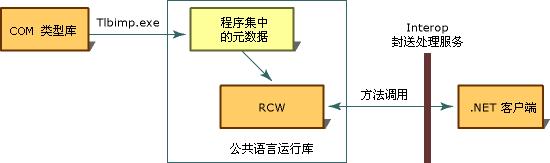
那么经过引用后,它是如何工作的呢?其实我想讨论的,也就是传统的COM是如何在.net下工作的。看下面的图示(载自MSDN

RCW.JPG
解释一下:

1、 首 先就是把COM封装成程序集中的元数 据,也就是.net可以使用的数据。VS2003给我们提供的工具是Tlibmp.exe,当你在引用COM时,VS2003就是用这个工具帮助我们把COM封装成了一个.net下可以用的元数据。也就是我们引用后,项目目录里会生成一个DLL文件,而它,就是.net可以使用的元数据。

2、 而 在运行时,RCW会为我们处理一些细节 问题,然后通过Interop来调用, 你就像使用.net对象一样的使用COM

我要说明的是:经过Tlbimp.exe封 装后的元数据,只是在.net项目开发 时使用的,运行时,真正的COM还是要 在目标机器上安装注册。下面的一篇文章很有参考价值,读者可以深入的理解一下,.net是 如何使用COM的。

http://www.microsoft.com/china/msdn/archives/library/dndotnet/html/bridge.asp

下面就是我们所关心的很二个问题,如何以COM的 形式来访问.net对象?

2部 份,如何让其它应用程序以传统的COM方 法来访问.net对象(原理)

请注意这里的措词,.net是 不能开发传统的COM的。因此,一些关 于.net开发COM以及ActiveX的说明都是不完全正确的。它的本质是把.net的对象,通过一些封装,然后暴露给操作系统,让其实的应用程序可以像 传统的COM方式那样来访问.net对象,而访问该对象的同时,因为该对象只能在.net下生成,所以运行环境还是要.net支持的。

先看一下MSDN上 的一个图示。

CCW.JPG
解释一下:

1. 托 管代码经编译成中间语言,想必大家都明白。而让其它应用程序也可以访问你所编译的DLL文 件,却有很多不同的方法。这里,就是一种,以COM的 形式暴露给OS

2. 这 是技术核心,通过Tlbxp.exe工 具,把DLL文件导出成组件(COM组件)类型库,也就是:把中间语言可以使用的DLL文件,通过工具,导出成COM可以使用的数据。

3. 注 册,还有一个工具regasm.exe, 可以把DLLOS(注册表)以COM的形式注册对象。这样OS里的COM运 行环境就知道系统里有一个对象,可以用GUID来 标识并生成和使用。

4. COM的方式实例化.net对象,先是应用程序向COM运行环境请求,要以生成一个对象(GUID标识)。COM运行环境通过注册信息找到COM类型数据库,然后通过.netCCW(COM Callable Wrapper)COM可调用包装)来访问.net下的DLL文件,然后生成.net对象,再返回给COM运行环境。而COM运行环境再以COM的形式把.net对象返回给应用程序。然后应用程序就像访问COM一样的来访问.net对象。

因此,.net不能 开发正真的COM,只是对.net对象进行一个封装,然后以COM的形式暴露给OS,让OS里 的其它应用程序也可以像访问COM那样 来访问.net对象。而本身的.net对象还是要.net环境来支持的。

好了,知道了它的原理后,我们就明白可以做什么事了。下面,我们就是如何来做事了。

3部 份,最简单的方法来暴露.net对象(VS2003)

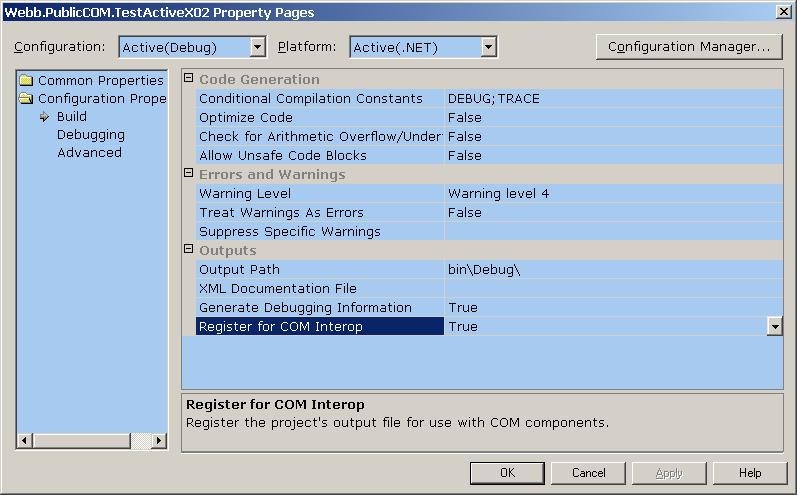
这个方法很简单,就是做一个Library项 目,然后把编译选项设定为Interop交 互为true.

projectproperty.JPG
编译过后,系统会自动的为你在
OS中注册一个COM,当然,有点类似ActiveX,就要看你的对象有没有界面了。

这里引用博客园里的另一文章给大家看看,应该有收获。

红马天下(http://www.cnblogs.com/homer/ )的这几篇文章:用C#编写ActiveX控 件

http://www.cnblogs.com/homer/archive/2005/01/04/86473.html

http://www.cnblogs.com/homer/archive/2005/01/08/88780.html

http://www.cnblogs.com/homer/archive/2005/01/26/97822.html

上面的几篇文章里介绍了一些操作细节,我这里就不重复了。上面的工作大部份都是系统自动给我们完成的,下面我们来讨论一些细节问题。

4部 份:以传统的COM方式向OS暴露.net对象(VS2003下的操作及实现)

1、 还 是new一个Library项目。

2、 添 加一个COM对象(要安装插件,后面有下载)

newcom.JPG

3、 看看这个插件为我们做了什么(代码):

using System;
using System.Runtime.InteropServices;

namespace Webb.PublicCOM.TestCOM01
{
Events raised by your COM class#region Events raised by your COM class
//
// TODO: Insert delegates for events raised by your class here.
//
//public delegate void Event1Handler(int i, int j);

[    Guid(
6C656B6C-F101-4CC8-A7C4-B2296A0A715C),
InterfaceType(ComInterfaceType.InterfaceIsIDispatch) ]
public interface IWebbTestCOM02Events
{
//
// TODO: Insert event handlers for events your class raises here.
//
//[DispId(1)] void Event1(int i, int j);
}

#endregion


Interface published by your COM class#region Interface published by your COM class
[    Guid(
BE268E05-CF9C-43B4-986E-720971A924A2),
InterfaceType(ComInterfaceType.InterfaceIsDual) ]
public interface IWebbTestCOM02
{
//
// TODO: Insert functions your class publishes here.
//
//[DispId(1)] int Function1(string s1, string s2);
}

#endregion


[    Guid(
B303E55E-F40A-4E8C-B94B-BE781E01274C),
ProgId(
Webb.PublicCOM.TestCOM01.WebbTestCOM02),
ClassInterface(ClassInterfaceType.None),
ComSourceInterfaces(
typeof(IWebbTestCOM02Events)) ]
public class WebbTestCOM02 : IWebbTestCOM02
{
//
// TODO: Insert events raised by your class here.
//
//public event Event1Handler Event1;

// A COM class must have a public parameterless constructor.
// Otherwise the class might not be registered for COM and
// cannot be created by CreateObject.
public WebbTestCOM02() : base()
{
}


//
// TODO: Implement the methods of your class interface here.
//
//public int Function1(string s1, string s2)
//{
// return 0;
//}
}

}

4、 删 除一些注释的代码,编译项目,你就可以得到一个已经向OS暴 露过的.net对象了。当然,你还可以 添加一些函数或者事件。编译过后,有一个DLL文 件,还有一个tlb文件,它就是用工具 导出后,向COM暴露的组件库数据。C++可以用该文件通过COM方式来访问.net对象,注意,这与C++写托管代码完全不同。源代码有一个用C++通过COM来访问.net对象的实例。

5、 用 其它应该程序来访问上面的对象。
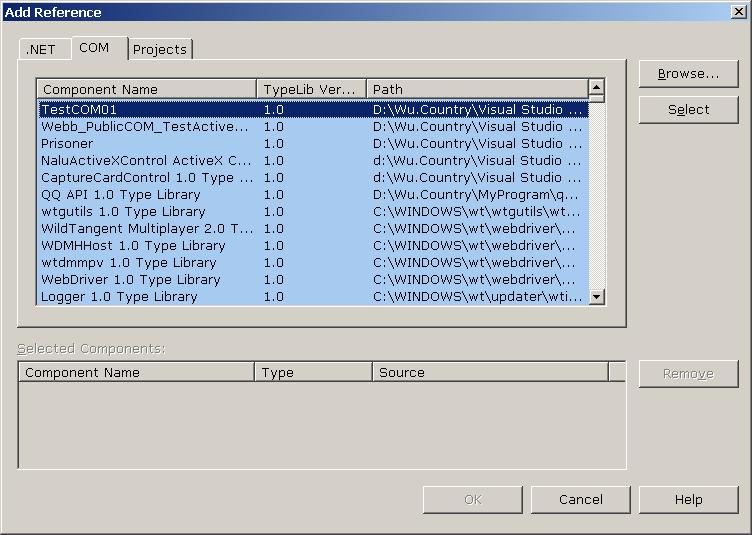
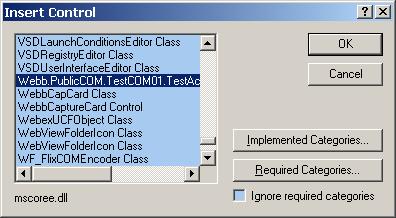
我们的目标很明确,就是以COM的方式来访问前面的.net对象,首先你可以在COM对象里找到我们编译过和注册过的对象:
selectCOM.JPG

如果你是在.net下 引用该COM,你会得到一个错误:

selectCOMerror.JPG
这里说明两个问题:

i. 我们在vs.net2003下 添加COM引用时,其实就是我第1部份里说的原理,而这里我们所引用的对象本身已经是.net对象,所以再引用时,是会出错的。这里是引用,不是运行时创建。

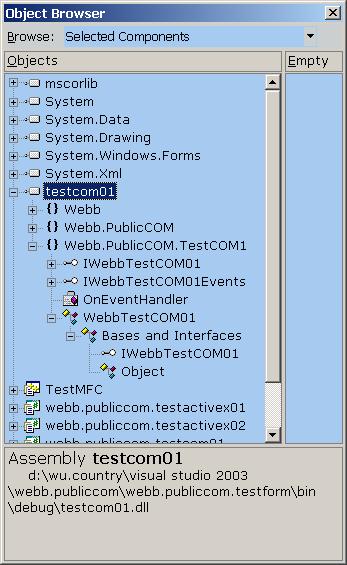
ii. 我们可以直接对DLL文 件引用,这与一般的.net程序集引用 是有一点区别的:

comview.JPG
可以看到,我们引用后的对象,与一般程序集的引用不一样,反而也
COM的引用很像。也就说,我们这里的引用是通过了RCW的。

接下来,你就可以自由的把你的.net对 象写的很完善了。大家应该可以注意到,我们写这个项目的时候,就是要遵守一些开发原则。因为COM的特殊性,我们的对象必须定义和实现一些接口,而在每种开发语言里,它的 实现方法是不一样的。本文暂时不讨论代码实现细节,示例代码里有一个例子,可以参考一下。

5部 份:以ActiveX方式向OS暴露.net对象(VS2003下的操作及实现)

接上面的思路,我们应该可以想到,以COM方 式向OS暴露.net对象,就是让我们的对象实现一些接口,定义一些必须信息。然后利用工 具向OS注册这些信息就行了。下面讨论 的就是,我们手动的修改和添加一些信息,让我们的.net对 象实现更多的接口,然后以ActiveX的 形式暴露给OS。首先说明,ActiveX是有页面的,因此我们可以从一个UserControl上开发。

在原来的项目中,添加一个TestActiveX01对 象,从UserControl继承。然 后给我们的对象添加一些特殊功能,让它以ActiveX的 形式暴露给OS

using System;
using System.Collections;
using System.ComponentModel;
using System.Drawing;
using System.Data;
using System.Windows.Forms;

// Add in these    using clauses for this example
using System.Runtime.InteropServices;
using System.Text;
using System.Reflection;
using Microsoft.Win32;


namespace Webb.PublicCOM.TestCOM01
{
/**//// <summary>
/// Summary description for TestActiveX03.
/// </summary>

[ProgId(Webb.PublicCOM.TestActiveX03)]
[ClassInterface(ClassInterfaceType.AutoDual)]
public class TestActiveX03 : System.Windows.Forms.UserControl
{
private System.Windows.Forms.PictureBox pictureBox1;
/**//// <summary>
/// Required designer variable.
/// </summary>

private System.ComponentModel.Container components = null;

public TestActiveX03()
{
// This call is required by the Windows.Forms Form Designer.
InitializeComponent();
// TODO: Add any initialization after the InitializeComponent call
}


/**//// <summary>
/// Clean up any resources being used.
/// </summary>

protected override void Dispose( bool disposing )
{
if( disposing )
{
if(components != null)
{
components.Dispose();
}

}

base.Dispose( disposing );
}


Component Designer generated code#region Component Designer generated code
/**//// <summary>
/// Required method for Designer support – do not modify
/// the contents of this method with the code editor.
/// </summary>

private void InitializeComponent()
{
System.Resources.ResourceManager resources
= new System.Resources.ResourceManager(typeof(TestActiveX03));
this.pictureBox1 = new System.Windows.Forms.PictureBox();
this.SuspendLayout();
//
// pictureBox1
//
this.pictureBox1.Image = ((System.Drawing.Image)(resources.GetObject(pictureBox1.Image)));
this.pictureBox1.Location = new System.Drawing.Point(0, 0);
this.pictureBox1.Name = pictureBox1;
this.pictureBox1.Size = new System.Drawing.Size(128, 40);
this.pictureBox1.TabIndex = 0;
this.pictureBox1.TabStop = false;
//
// TestActiveX03
//
this.Controls.Add(this.pictureBox1);
this.Name = TestActiveX03;
this.Size = new System.Drawing.Size(200, 152);
this.ResumeLayout(false);

}

#endregion


/**//// <summary>
/// Register the class as a    control    and    set    it’s CodeBase entry
/// </summary>
/// <param name=”key”>The registry key of the control</param>

[ComRegisterFunction()]
public static void RegisterClass ( string key )
{
// Strip off HKEY_CLASSES_ROOT\ from the passed key as I don’t need it
StringBuilder    sb = new StringBuilder ( key ) ;
sb.Replace(
@”HKEY_CLASSES_ROOT\,“”) ;
// Open the CLSID\{guid} key for write access
RegistryKey k = Registry.ClassesRoot.OpenSubKey(sb.ToString(),true);
// And create    the    ‘Control’ key –    this allows    it to show up in
// the ActiveX control container
RegistryKey ctrl = k.CreateSubKey    ( Control ) ;
ctrl.Close ( ) ;
// Next create the CodeBase entry    – needed if    not    string named and GACced.
RegistryKey inprocServer32 = k.OpenSubKey    ( InprocServer32 , true )    ;
inprocServer32.SetValue (
CodeBase , Assembly.GetExecutingAssembly().CodeBase )    ;
inprocServer32.Close ( ) ;
// Finally close the main    key
k.Close (    ) ;
}


/**//// <summary>
/// Called to unregister the control
/// </summary>
/// <param name=”key”>Tke registry key</param>

[ComUnregisterFunction()]
public static void UnregisterClass ( string key    )
{
StringBuilder    sb
= new StringBuilder ( key ) ;
sb.Replace(
@”HKEY_CLASSES_ROOT\,“”) ;
// Open    HKCR\CLSID\{guid} for write    access
RegistryKey    k = Registry.ClassesRoot.OpenSubKey(sb.ToString(),true);
// Delete the ‘Control’    key, but don’t throw an    exception if it    does not exist
k.DeleteSubKey ( Control , false ) ;
// Next    open up    InprocServer32
RegistryKey    inprocServer32 = k.OpenSubKey ( InprocServer32 , true ) ;
// And delete the CodeBase key,    again not throwing if missing
k.DeleteSubKey ( CodeBase , false ) ;
// Finally close the main key
k.Close    ( )    ;
}

}

}

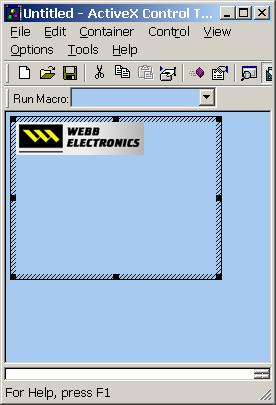
编译,然而用Active Control Test Container 来测试和查看我们的ActiveX:

selectActiveX.JPG
可以看到,经过特殊方法实现后的对象可以在
ActiveX中查看的到,而且可以添加到容器中:

ActiveXView.JPG
接下来的工作就是一些功能的实现细节问题了,本文暂时不讨论这些内 容。

最后一个问题就是在其它语言中通过COM来 访问我们的.net对象,我们在C++下经过测试并实现了一些细节问题,事件等。但源代码不在示例中。

总结:.net开发COM或者ActiveX,其实是把写好的.net对象(当然是准备暴露给OS的),实现一些特殊的接口,通过工具把元数据导出成COM可用的组件库数据,然后注册给OS。运行时,通过CCW来动态的管理与维护.net对象。而对于用户来说,他就像访问COM一样访问.net对象。

MSDN参考:

http://msdn2.microsoft.com/zh-cn/library/8bwh56xe(VS.80).aspx

http://msdn2.microsoft.com/zh-cn/library/e753eftz(vs.80).aspx

下载文档:

1、 VS2003COM开发插件。

http://files.cnblogs.com/WuCountry/CSComSetup.zip

2、 示 例项目代码。
http://files.cnblogs.com/WuCountry/Webb.PublicCOM.zip

3、 本 文doc文档。
http://files.cnblogs.com/WuCountry/TempDoc.zip

[转载]整理了几条 LogParser 命令

mikel阅读(1122)

[转载]http://www.room702.cn/index.php/archives/244

注入分析:
LogParser "select time,c-ip,cs-uri-stem,cs-uri-query,sc-status,cs(User-Agent) from ex080228.log where cs-uri-query LIKE '%select%'"

查询日志文件:ex080228.log , 查询关键字:select

==================================================

反射型XSS分析:
LogParser "select time,c-ip,cs-uri-stem,cs-uri-query,sc-status,cs(User-Agent) from ex080228.log where cs-uri-query LIKE '%<script>%'"

查询日志文件:ex080228.log ,查询关键字:<script>

==================================================

特定时间记录搜索:
LogParser "select time,c-ip,cs-uri-stem,cs-uri-query,sc-status,cs(User-Agent) from ex080228.log where time between TIMESTAMP( '09:07:00', 'hh:mm:ss' ) and TIMESTAMP( '09:08:00', 'hh:mm:ss' )"

查询日志文件:ex080228.log ,搜索时间段:09:07:00 至 09:08:00

==================================================

根据IP地址统计访问情况:
LogParser "select date,time,c-ip,cs-uri-stem,cs-uri-query,cs(User-Agent),sc-status from ex080228.log WHERE IPV4_TO_INT(c-ip) BETWEEN IPV4_TO_INT('172.16.9.0') AND IPV4_TO_INT('172.16.9.255')" 

查询日志文件:ex080228.log , 搜索IP段:172.16.9.0/24

==================================================

目录猜解搜索:
LogParser "select time,c-ip,count(time) as BAD from ex080228.log where sc-status=404 group by time,c-ip having BAD>5"

查询日志文件:ex080228.log , 搜索错误次数大于N次:5

==================================================

表单破解搜索:
LogParser "select time,c-ip,cs-uri-stem,count(time,cs-uri-stem) as BAD from ex090609.log where sc-status=200 and cs-method='POST' group by time,c-ip,cs-uri-stem having BAD>4"

查询日志文件:ex090609.log , 搜索同一秒内POST次数大于N次:4

==================================================

异常User-Agent搜索:
LogParser "select time,c-ip,cs-uri-stem,cs-uri-query,sc-status,cs(User-Agent) from ex080228.log where cs(User-Agent) NOT LIKE 'Mozilla%'"

查询日志文件:ex080228.log , 搜索User-Agent:全部未以Mozilla开头的User-Agent

==================================================

不正常的HTTP Method
LogParser "select time,c-ip,cs-method,cs-uri-stem from ex090609.log where cs-method in ('HEAD';'OPTIONS';'PUT';'MOVE';'COPY';'TRACE';'DELETE')"

查询日志文件:ex090609.log , 搜索异常方法:('HEAD';'OPTIONS';'PUT';'MOVE';'COPY';'TRACE';'DELETE')"


[转载]网站策划必备三大软件及介绍(一)

mikel阅读(1155)

[转载]网站策划必备三大软件及介绍(一) – 站长网 admin5.com.

一个网站项目立项以后,每个功能、页面的制作一般都会走这样一个流程:

项目策划(产品、功能策划及策划论证) 、界面设计与前期用户体验设计(ui+ue)、页面制作与前端脚本及后期用户体验设计、功能的程序编写与实现、功能测试、内容填充、全面检查与整站优化

我们可以发现,产品策划人员从开始一直到最后,都贯穿于整个项目的实施之中,而策划人员自己本身需要出具一些相关的图表或者文档,一般包括项目 结构图、功能流程图、页面框图、项目进度表以及对应的说明文档。这里我向大家推荐三个软件,一是Mindjet MindManager ,专门用于结构图制作,二是亿图,用于流程图制作,三是Axure,用于线框图制作,由于三者一起介绍篇幅太长,呵呵,分二部分到admin5来发。本文 就主要介绍Mindjet MindManager 与亿图(EdrawMax)。

这几个相关的图表与文档的制作中,说明文档我们可以用微软的word来实现,而项目结构图则可以使用Mindjet MindManager来实现,这个软件Mindjet MindManager 最新版本为V8.0,目前比较好用的是6.0汉化版。从字面上大家可以发现它有“思维引导管理”的意思,也就是使用此软件可以很方便的把自己的想法或者团 队的想法给充分的展现出来,经过最终的整理,将可以得到一个完整的结构图表。我们以vb86点com为例子,来看看一下Mindjet MindManager 的特点。我花几分钟制作出一张图表,见图1。

图1

这样一来,网站的结构就了然于胸了。也方便给其它流程的同事进行演示,此软件有几个特点:

a.每个节点都可以点击收缩或者伸展

b.可以导出常见的图片jpg、png、gif、bmp以及word、html等多种格式

c.可以在主文件中插入多个类似文档,实现不同文档之间的切换

d.支持各主题(方块)的局部对齐与全局对齐

e支持自定义样式等

Mindjet MindManager 的功能很多,如果大家有兴趣,可以去慢慢发掘。接下来我们来说一说流程图制作。

对于项目来说,有许多的流程,包括团队工作流程,项目的功能流程,用户体验流程等,我就从团队工作流程这一点来给大家介绍一下我常用的工具:亿 图(EdrawMax)。

此软件由上海风山网络科技有限公司出品,目前最版本是v5.0,准备推出。目前好用的版本是4.0版本。此软件包含了大量的图表例子,上手简 单。我们还用vb86团队工作流程作为例子,大家看一张表,见图2.

图2

我相信大家一定能制作出比我这个漂亮很多的图表来。

本软件有几个特点:

1、巨量的符号图库,可以满足你一切需求

2、可以导出多种格式,包括图形、文档格式、网页格式等

3、超多的例子,有许多只需要一改就能用

4、可以自定义多种主题风格,当然已经有很多主题提供了

5、图形之间支持吸附,很方便操作

6、标尺与辅助线非常好用,并有吸附功能

7、可自定义背景

8、可以自定义图片、符号、以及相关的几何参数等

总之,功能非常强大,制作流程图一流了。篇幅已经很长了,下一章我们再来介绍另一款常用工具:Axure线框图制作工具。

说明一下,www.vb86.com是我的小站,刚开两天,本文目的在于分享好用的策划工具(当然你也可以用来做很多东西),其次昵,也想在 admin5发一下链接,呵呵。感谢大家,欢迎一起分享你的好软件哦。

[转载]Javascript 通过json自动生成Dom小示例

mikel阅读(1143)

[转载]Javascript 通过json自动生成Dom小示例 – 花吻道 – 博客园.

json转html 三重奏

原料:json

var json={
‘div’:{id:’flower’,className:”a1″,sub:[
{
‘ul’:{id:’flower1′,className:[“a2″,”a3″],sub:[
{‘li’:{num:3,con:”内容内容内容”,fn:{‘click’:function(){alert(‘我是LiLi’)}}}}
]}
},
{
‘ul’:{id:’flower4′,className:[“a2″,”a3″],sub:[
{‘li’:{num:3,con:”第2轮了”,fn:{‘click’:function(){alert(‘我是LiLi’)}}}}
]}
},
{
‘span’:{id:’q’,con:”我是span”}
}
]}
}

id=id

className=class

num=循环次数

fn=绑定函数

con=元素内容

sub =代表有子节

主 菜:method

JsonToHtml={
init:function(data,parent){//jsonDB,父元素
for(var attr in data){
if(data[attr][id]){var num=1}else{var num=data[attr][num]||1}//如果存在id,则循环默认为1,因为id不可重复
for(var j=0;j<num;j++){
var obj= document.createElement(attr);
parent ? parent.appendChild(obj) : document.body.appendChild(obj);//递归时传入父元素,没有则默认从body输出
for(var attr2 in data[attr]){
var _tempAttr=data[attr][attr2];
switch(attr2){
case id:
obj.id=_tempAttr;
break;
case className: //支持多个class传入~简了点~
if(_tempAttr.length && _tempAttr.pop){
for(var k=0;k<_tempAttr.length;++k){
obj.className= obj.className+ +_tempAttr[k] ;
}
}else{ obj.className =_tempAttr;}
break;
case sub: //如果有子节点则开始递归
for(var i=0;i<_tempAttr.length;i++){
_tempAttr[i].sub ? this.init(_tempAttr[i]) : this.init(_tempAttr[i],obj)
}
break;
case con://设置内容,可以生成新的子元素
obj.innerHTML=_tempAttr;
break;
case num:
break;
case fn://绑定方法
for(var fns in _tempAttr){
if (window.addEventListener) {
obj.addEventListener(fns, _tempAttr[fns], false);
} else {
if (window.attachEvent) {
obj.attachEvent(on + fns, _tempAttr[fns]);
}
}
}
break;
default : //设置属性
obj.setAttribute(attr2,_tempAttr);break;
}
}
}
}
return this;
}
}

JsonToHtml.init(json); //初始化

上 菜

<div id=”flower” class=”a1″>
<ul id=”flower1″ class=”a2 a3″>
<li>内容内容内容</li>
<li>内容内容内容</li>
<li>内容内容内容</li>
</ul>
<ul id=”flower4″ class=”a2 a3″>
<li>第2轮了</li>
<li>第2轮了</li>
<li>第2轮了</li>
</ul>
<span id=”q”>我是span</span>
<div>

主 要还是通过递归和迭代来遍历json成员生成html元素 ,比较好的是num能制定循环次数可以少写很多代码.具体应用看场景了

这 只是个小例子,期待后续!